Yes #3 · the one that makes you go outside
ORBIT.
Yes, and —
Tell it where you are standing and it will tell you which way to face at 7:36 tonight, and for how long.
Yes #3 · the one that makes you go outside
Tell it where you are standing and it will tell you which way to face at 7:36 tonight, and for how long.
Grade A minusSay yes to looking up — then look at the date on the elements before you trust the minute.
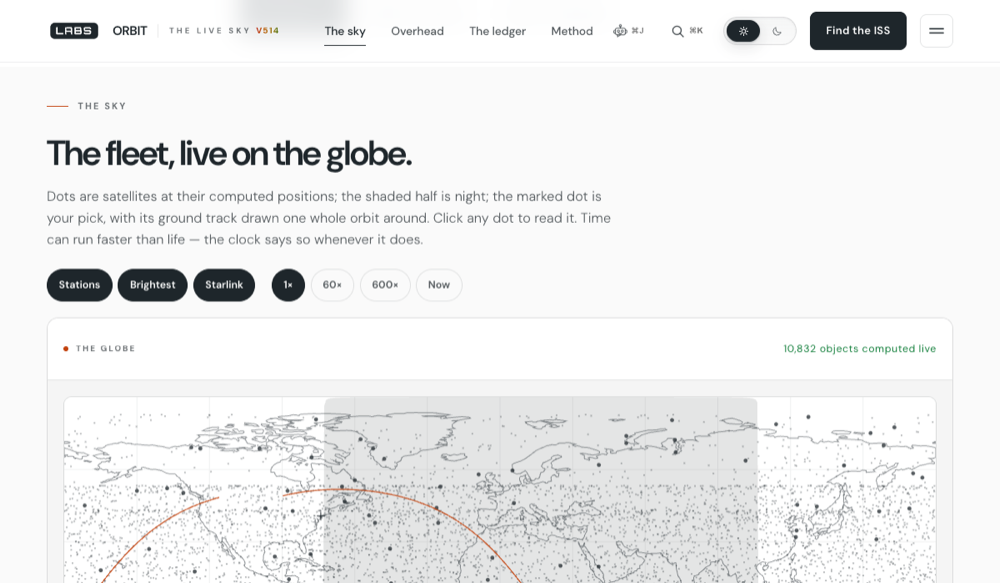
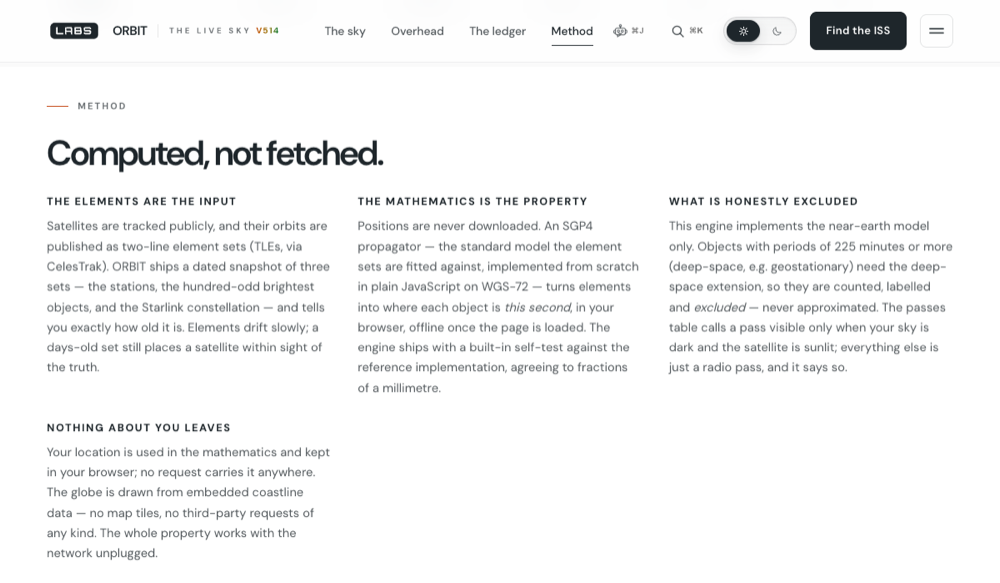
Nothing here is a picture of the sky. Every dot is a position the browser worked out, this second, from published orbital elements — using an SGP4 propagator written from scratch, in plain JavaScript, on the WGS-72 gravity model the element sets are fitted against. Twenty-four kilobytes of code, with a self-test that agrees with the reference implementation to fractions of a millimetre.
Pull the network cable out and the page keeps running: there was never anything to fetch, the coastlines are embedded, and your latitude and longitude go no further than the arithmetic. Run the clock at 600× and watch the Starlink shell comb the planet like a rake.
“Computed, not fetched.”ORBIT, on its own method
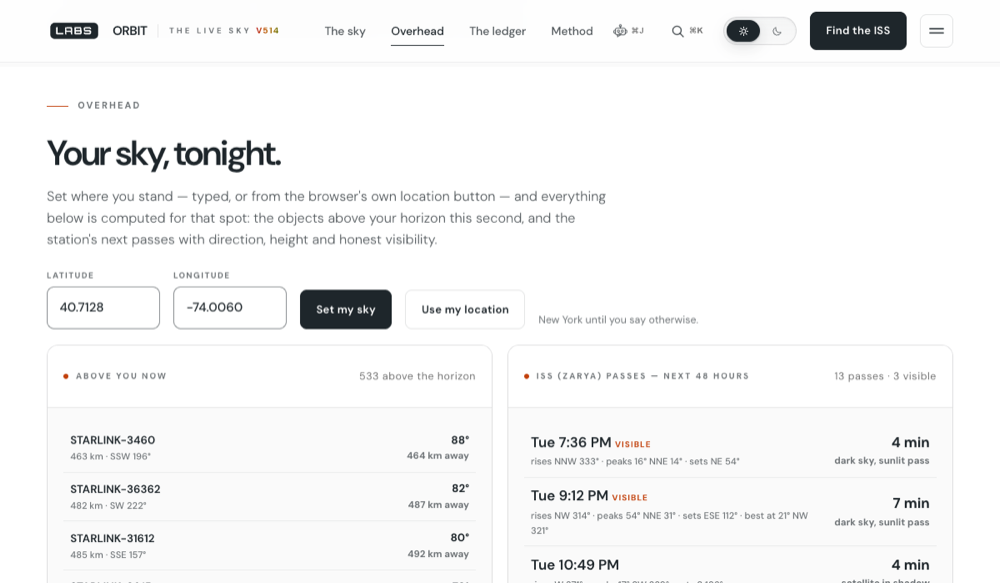
Then it turns a good demo into something you use: type where you stand and the globe becomes a viewing guide — a list of passes with an opinion. It will only call a pass visible when your sky is dark while the satellite is still in sunlight, the only way you see one with your eyes. Everything else, it says, is a radio pass. From New York, on the night we looked, that cut thirteen station passes to three worth a coat, and told us to face north-north-west at 7:36 and follow it to 16° before it set in the north-east.
The refusals are the best-written part of it. The engine implements the near-earth model only, so anything with a period of 225 minutes or more — geostationary included — is counted, labelled and left out rather than approximated into a lie.
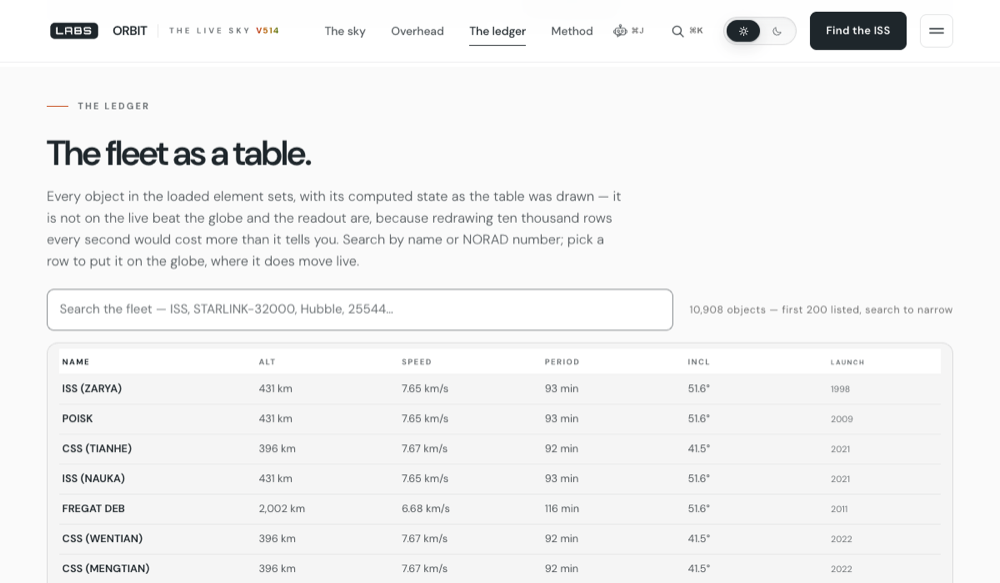
The elements are old, and age is the one thing an orbital prediction cannot shrug off. Its own readout said: element snapshot 2026-08-27T16:05:31Z — 26.3 days old. Element sets are fitted to a moment and drift; drag pulls low-orbit objects off their published track, so a month-old set puts a satellite roughly in the right place, not at the right minute. ORBIT is straight about this — it stamps the age on the screen and its footer says accuracy is “plenty to point a finger at the sky, not to fly anything” — yet the headline sells tonight's viewing guide, and that lives or dies on the minute. A monthly refresh would fix it. Second, smaller: the totals disagree. The globe said 10,833 objects on one load and 10,832 on the next, the readout beside it 10,908, and the file behind both holds 10,911 element sets. Four numbers, one fleet, no note saying which is which.
One thing we checked rather than assumed: that exclusion excludes nobody. We computed the period of all 10,911 element sets in the snapshot, and every one comes in under 225 minutes. The discipline is real, the caveat free, and it will matter when someone adds the geostationary belt. Yes, and — go outside at 7:36.
Measured by this desk against https://labs.llc/orbit/ in a headless browser with analytics blocked at the network layer, 2026-09-22 at 22:38:40Z, 22:39:09Z and 22:44:15Z. The 10,911 element sets and their periods were counted out of the live data file fetched at 22:34:42Z, by parsing the mean motion from each object's second line. Overhead figures are for the page's default position, 40.7128, −74.0060.